

Custom Accessible Web Design
Design and build new websites with accessibility built in and tested against WCAG from the first wireframe.
Accessible web design services in Toronto start from one principle: a website works when everyone can use it. We test and remediate websites against WCAG so people using screen readers, keyboard navigation, magnification and voice input can complete the same tasks as everyone else. We also design and build new websites with accessibility in place from the first wireframe.
Create an inclusive digital presence that broadens your audience, improves user experience, and demonstrates your commitment to accessibility. Talk to an Expert today to get started on your accessible web design journey.
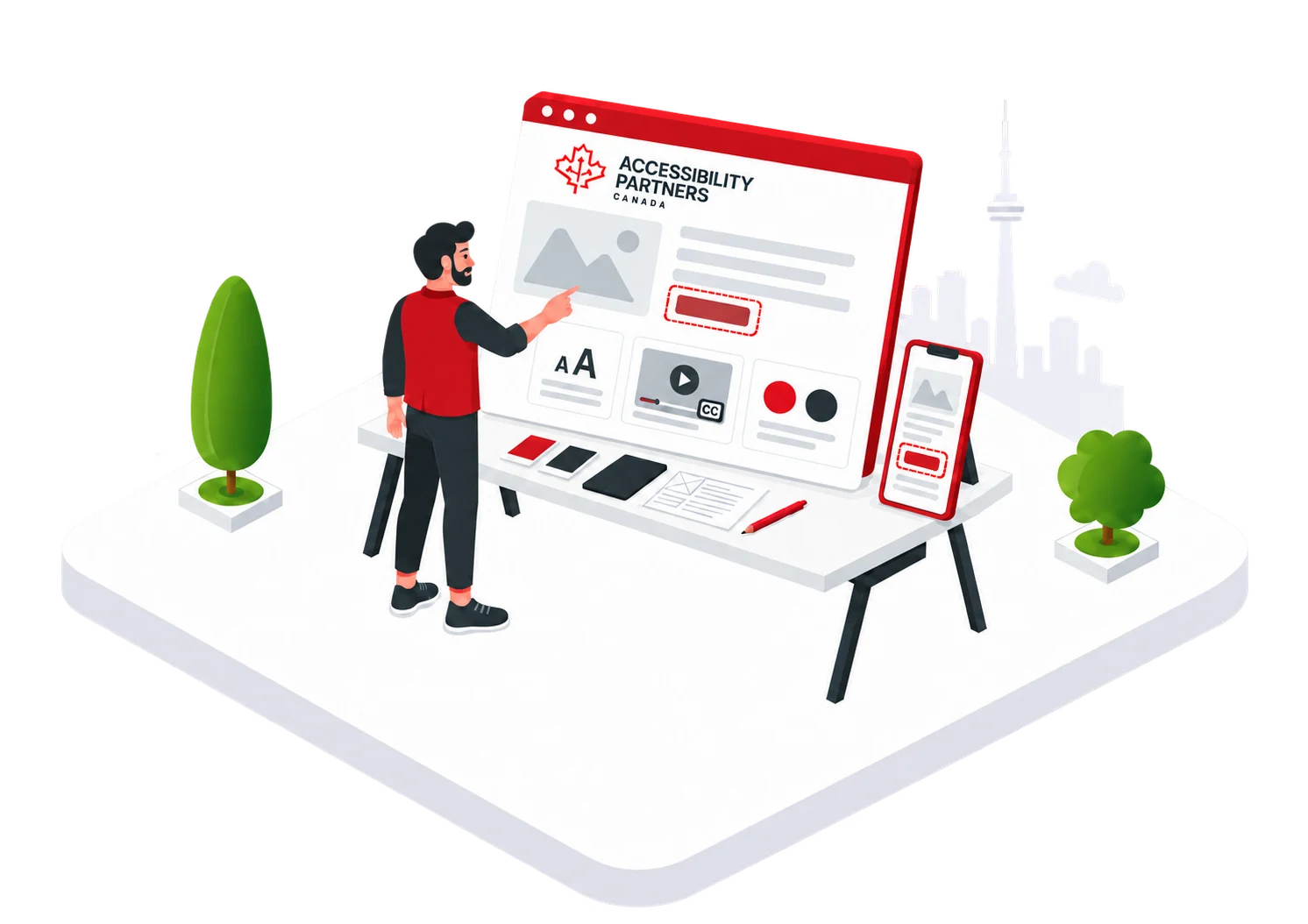
Accessible web design means building the barriers out of a website. In practice: every function works from a keyboard alone, images carry text alternatives, forms have labels a screen reader announces, colour contrast meets WCAG ratios, video carries captions, and page structure uses real headings so assistive technology can navigate. WCAG is the technical standard this work is tested against; meeting it is strong evidence of accessibility, but conformance to a standard is not the same thing as compliance with every law that may apply to your organization.
Accessible web design in Toronto is crucial for businesses for several reasons:

Legal Compliance: In Ontario, the AODA requires designated public sector organizations and businesses and non-profits with 50 or more employees in Ontario to make their public websites and web content conform to WCAG 2.0 Level AA. Federally regulated organizations have separate obligations under the Accessible Canada Act and its regulations. Whether and how these requirements apply depends on the organization, so the first step is confirming which rules cover you.
Expanding Your Audience: In Canada, 27% of people aged 15 and over, 8.0 million people, have a disability (Canadian Survey on Disability, 2022). By making your website accessible, you reach a broader audience and support equal access for all users.
Enhanced User Experience: Accessibility features like intuitive navigation, clear text, and multimedia captions benefit all users, not just those with disabilities, improving overall usability and engagement.
SEO Benefits: An accessible website is not automatically ranked higher. What is true: descriptive headings, meaningful link text and well-structured content serve both assistive technology and search engines, so accessibility work and search performance often improve together.
Social Responsibilities: Demonstrating a commitment to inclusivity enhances your brand’s reputation and builds customer loyalty, showing that your business values diversity and equity.
We offer a full suite of accessible web design services in Toronto built around your organization’s needs:
Design and build new websites with accessibility built in and tested against WCAG from the first wireframe.
Evaluate your existing website against WCAG, and against the AODA requirements that apply to your organization.
Update your current website to address accessibility gaps.
Make your mobile site accessible for touch-based and assistive technologies.
Add captions, transcripts, and audio descriptions for videos and other multimedia content.
Conduct manual and automated testing to check that your website meets accessibility standards.
Train your designers, developers and content teams to build and maintain accessible websites.
Our team includes people with lived experience of disability, and we test with real users of assistive technology. Based in downtown Toronto, we serve organizations across the GTA and Ontario. Here’s why we’re the right choice for accessible web design in Toronto:
Our team includes CPWA-certified professionals with extensive knowledge of WCAG, AODA, and global accessibility standards.
From audits and remediation to ongoing support, we offer end-to-end accessible web design services.
Every project is customized to meet your unique requirements and goals.
We’re passionate about creating digital spaces that are accessible and welcoming to everyone.
A WCAG audit report documents how a specific website performs against WCAG success criteria: what passes, what fails, where, and how to fix it. A VPAT is a template; the completed document is an Accessibility Conformance Report (ACR), which states a product’s conformance claim criterion by criterion, usually for procurement. If a buyer asks for your VPAT, they want an ACR. If you want to know what to fix on your site, you want a WCAG audit report. We produce both, and they draw on the same testing.
Talk to an Expert today and let Accessibility Partners help you build a website that’s accessible and inclusive.
You can determine your website’s accessibility by conducting an accessibility audit, which evaluates your site against WCAG, and against the AODA requirements that apply to your organization.
Automated tools catch only a portion of WCAG failures. Manual testing, including keyboard-only passes and screen reader testing, is how the remainder is found. Any audit that is automated-only is incomplete.
It depends on the size and state of the site. Remediation time depends on what the audit finds and who implements the fixes. We scope both phases with dates before work starts.
Pricing is quoted per project, based on the number of pages and templates, the complexity of interactive features, and whether remediation is included. Ask us for a quote; we respond with a fixed scope and price rather than an open-ended rate.
Yes. Websites change, and accessibility holds only if new content and features are tested as they ship. We offer re-testing after releases and periodic reviews, scoped to how often your site changes.
Most existing websites can be remediated. An audit tells you which: if the underlying platform and templates are sound, fixes are applied in place; if the structure itself is the barrier, we say so and quantify the rebuild case honestly before you spend on remediation.