

Website Accessibility Audits
WCAG 2.2 testing with prioritized findings.
Our accessibility consultants in Winnipeg help organizations find and remove barriers across websites, documents, facilities, and services. We audit against WCAG, remediate what fails, train the teams who publish and serve, and build the accessibility plans and policies that keep the work on track. Most Manitoba clients arrive with one question: what does the Accessibility for Manitobans Act actually require of us? That is where we start, because the answer depends on your organization, and the right plan follows from it.
The Accessibility for Manitobans Act sets mandatory standards that arrive in stages, and which ones bind you depends on what your organization does. The customer service and employment standards are in force. The information and communication standard requires WCAG 2.1 Level AA for web content: public sector organizations have been covered since May 1, 2024, and private sector businesses and non-profits since May 1, 2025, so Manitoba’s web standard reaches every business and non-profit with at least one employee, while Ontario’s AODA website requirement reaches private organizations only once they have 50 or more employees in Ontario. We help you confirm which standards apply, assess where you stand, and close the gaps in order of impact. Consulting supports compliance; the work your organization does with it is what achieves it.
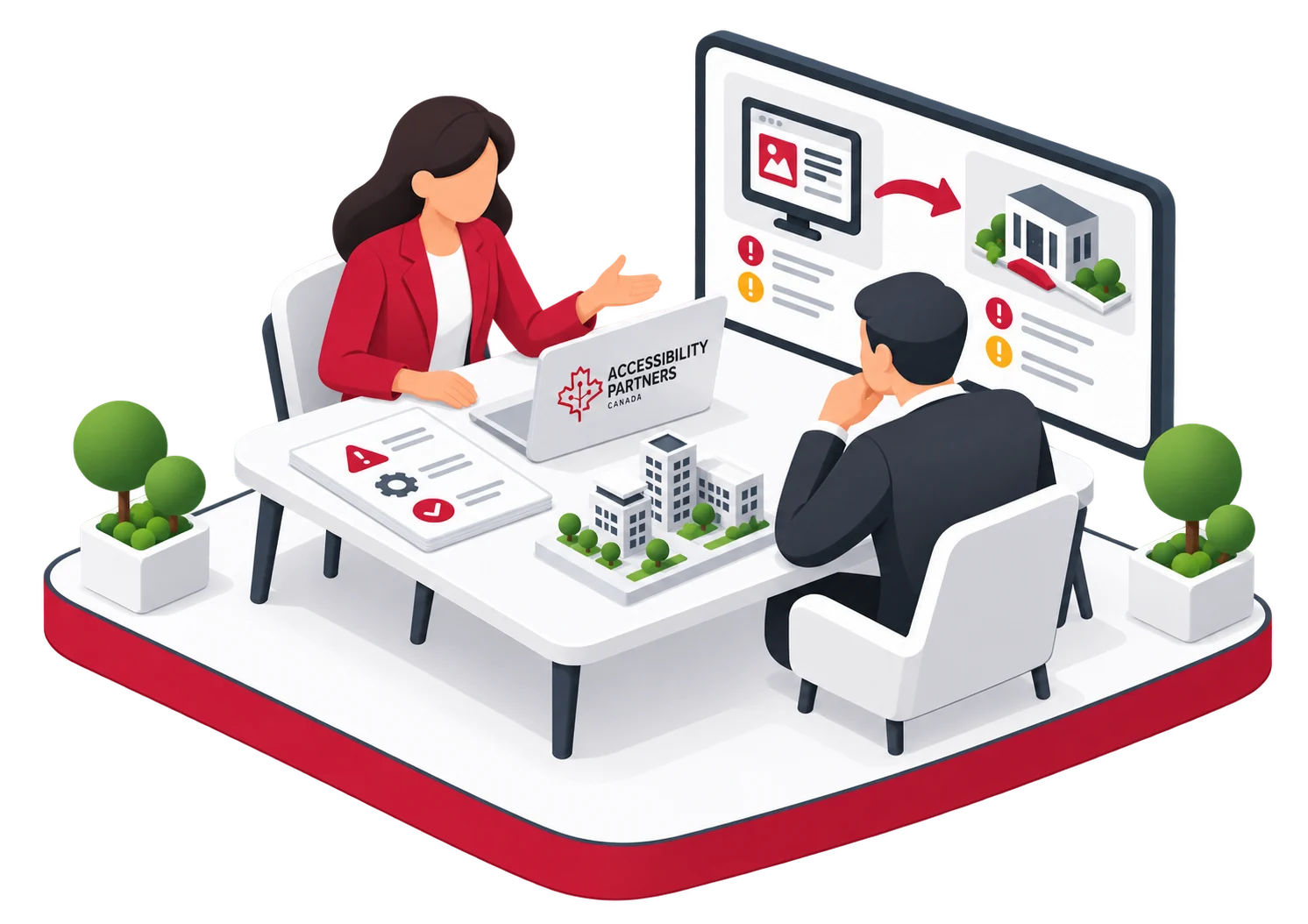
We work as partners, not report generators. Every engagement follows four moves: understand how your organization serves people and which obligations apply; assess the barriers across the channels in scope; prioritize fixes by user impact and legal exposure; and support your team through implementation and re-testing. Our Manitoba work centres on the AMA, WCAG, and, for federally regulated organizations, the Accessible Canada Act. For clients who also serve US markets, we test against ADA expectations as clearly labelled cross-border scope.
Step 1 – Discovery: we confirm your obligations and the channels in scope, from web and documents to facilities and service delivery.
Step 2 – Assessment: audits of the agreed scope, combining automated checks with manual testing, including assistive technology.
Step 3 – Prioritized roadmap: findings ranked by user impact and exposure, with budget-ready recommendations.
Step 4 – Implementation support: remediation help, training, and re-testing that verifies fixes rather than assuming them.

We draft and review accessibility policies, procurement language, and customer service procedures. One distinction matters in Manitoba: public sector bodies must prepare and update accessibility plans under the AMA, while for private businesses and non-profits a plan is not mandated but is the most effective way to sequence compliance with the standards that do apply.

Our web accessibility consulting starts with an audit: websites, applications, and documents tested against WCAG 2.2 Level AA using automated tools plus manual passes with screen readers and keyboard-only navigation, including testing by people who use assistive technology daily. You receive findings mapped to the success criteria they fail, prioritized remediation guidance, and, where procurement requires it, VPAT-based Accessibility Conformance Reports. An audit documents where you stand; WCAG has no official certification, and we say so rather than sell one.

Our building accessibility consultants assess entrances, washrooms, wayfinding, parking, and emergency egress against the Manitoba Building Code accessibility provisions and CSA B651, with findings sequenced so barrier removal lands in capital plans rather than binders.

The AMA requires training under its standards, beginning with customer service. We deliver AMA compliance training, digital accessibility training for web and content teams, and awareness training for all staff, available online, instructor-led, or in person. See our accessibility compliance training for Manitoba.
Our team includes CPWA-certified professionals and people with lived experience of disability, and we test with real users of assistive technology. We have delivered accessibility engagements for all three levels of government and for private organizations across Canada. We name the obligations that actually apply to you rather than implying every law applies to everyone, and our recommendations come with the evidence to defend them.
WCAG 2.2 testing with prioritized findings.
Fixes applied and re-tested.
PDF/UA and WCAG conformant documents.
Accessibility Conformance Reports for procurement.
Courses for every role, AMA to WCAG.
An accessibility consultant identifies the barriers in your websites, documents, facilities, and services, maps the obligations that apply to your organization, and builds a prioritized plan to remove them, then supports your team through remediation and verification.
It depends on your organization. The customer service and employment standards are in force, and the information and communication standard requires WCAG 2.1 Level AA for web content: public sector organizations since May 1, 2024, and private businesses and non-profits since May 1, 2025. The first step of any engagement is confirming which standards cover you.
Timeline is set at scoping, once we know your pages, templates, and document volume, and we commit to dates before work begins. Most website audits complete within a few weeks.
Yes. We provide remediation support across code, content, and documents, and we re-test every reported issue so your compliance position rests on verified fixes.
After any major redesign or platform change, and on a periodic cycle, commonly annual, between them. Accessibility holds only if new content and features are tested as they ship, which is why we pair audits with training and publishing workflows.